Darkness (motif in *Heart of Darkness*)
Heart of DarknessDarkness (motif in Heart of Darkness) is more than the absence of light: it is the story’s shifting image for an environment that resists human command, an experience that language cannot fully transmit, and a moral knowledge that characters struggle to face. Through Charles Marlow’s journey, darkness surrounds the wilderness and unsettles distinctions between civilization and savagery; after Kurtz’s death, it enters the drawing room and shapes Marlow’s decision to deceive The Intended. The motif’s force lies in these crossings between landscape, consciousness, and speech: what first appears remote and external returns as an intimate burden.
Landscape and the Limits of Control
The motif becomes palpable in the landscape along the river. Marlow describes the waterway as deserted and difficult to navigate, threading among wooded islands and shoals beneath long stretches of gloom. Its scale and silence disorient him: the river seems to lead away from everything familiar, while the forest’s stillness feels less like peace than an implacable force with an inscrutable intention. Darkness here marks a world that cannot be reduced to a comprehensible backdrop. It appears to watch the travelers, even as the obstacles of the channel demand their practical attention.
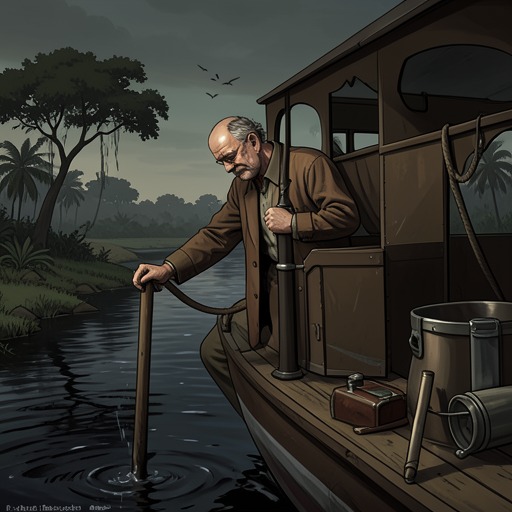
That practical attention briefly shields Marlow from what he calls the inner truth. He must search for hidden banks and sunken stones, avoid snags that could destroy the steamer, and find wood for the next day’s steaming. These surface tasks absorb his time; he says that reality fades while he attends to them, although he still feels the stillness watching him. The contrast makes darkness both a setting and a pressure on perception: work can hold immediate danger at bay, but it cannot make the larger mystery disappear.
The journey also gives darkness a historical and psychological dimension. Marlow imagines traveling back to the earliest beginnings of the world, then describes the land as an unknown planet. Nighttime drums travel through the trees, their meaning—war, peace, or prayer—unreadable to the travelers. The recurring uncertainty does not resolve into a single explanation. Darkness names the distance between the people aboard the steamer and the life around them, but also the limits of their confidence that they can interpret what they witness.
Human Kinship and the Unsettling Wilderness
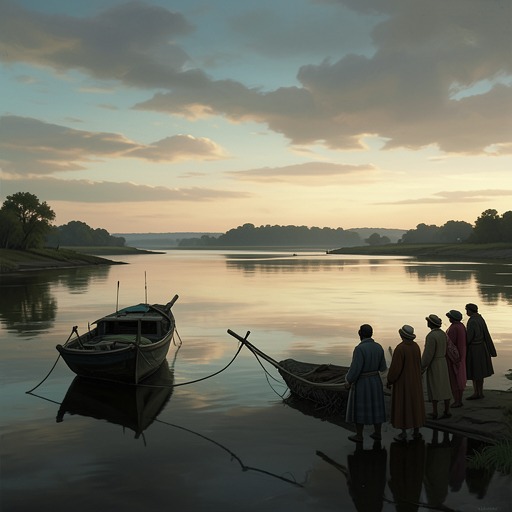
That uncertainty sharpens when Marlow sees people on the shore. The scene first strikes him as monstrous and unearthly, yet he rejects the conclusion that the people are inhuman. What disturbs him most is the possibility of shared humanity: their cries and movement awaken a faint response in him, a sense of remote kinship and of meanings he cannot confidently decipher. Darkness therefore complicates the travelers’ habitual division between themselves and those they encounter. It does not simply reveal an alien world; it makes the separation itself appear unstable.
Marlow insists that principles and the outward forms of civilized life are inadequate when confronted with this experience. What matters, in his account, is a deliberate inner belief and the ability to answer with one’s own strength. Yet he does not abandon the steamer to join the scene. He remains occupied with its damaged steam pipes, steering, snags, and the work of keeping it moving. The episode sets an inward encounter with disturbing kinship against the practical demands of the voyage. Darkness brings the encounter close, but the tasks of travel also give Marlow a way to continue without resolving it.
Darkness, Memory, and the Failure of Language
Marlow’s reflections on storytelling extend the motif from perception to narration. He says that conveying the life-sensation of a particular period is impossible: experience has a truth and meaning that a later account cannot fully reproduce. People, he says, live as they dream—alone. This claim gives the story’s darkness a formal role. Marlow can relate events and images, but his narrative repeatedly acknowledges the gap between describing an experience and making another person inhabit it. The motif’s obscurity is thus also a limit on what testimony can deliver.
The London visit after Kurtz’s death shows that the past does not remain safely behind the teller. Before entering the house, Marlow sees Kurtz in a vision on the stretcher, his mouth open as if to devour the earth and its people. The image joins Kurtz’s eloquence and appetite to memories of the forest, the obedient crowd, and the muffled drumbeat, which Marlow associates with a conquering darkness. As he waits at the door, he recalls Kurtz’s claim that the ivory was his and that he wanted no more than justice. The repeated appeal to justice sits against the memory of Kurtz’s voracious desire and desperate conduct; darkness gathers around a contradiction that Marlow cannot make disappear by returning to Europe.
The Drawing Room and the Concealed Truth
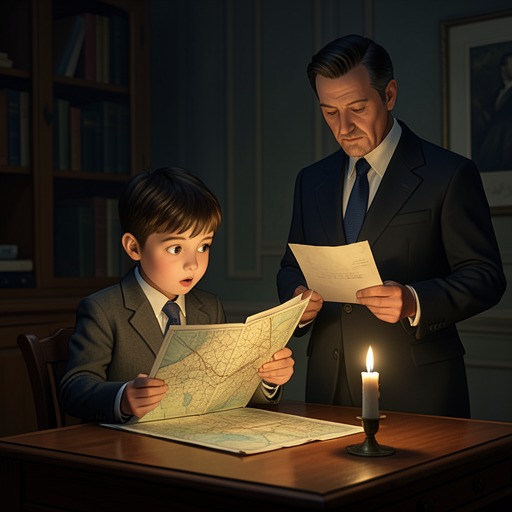
In the drawing room, darkness changes scale but not character. More than a year after Kurtz’s death, The Intended receives Marlow in mourning. The room grows darker as the evening light fades, while she speaks of Kurtz as a man who drew out what was best in others and mourns the loss not only to herself but to the world. Her faith in him stands in tension with the memories Marlow has just carried to her door. When she asks for his last word, Marlow hears the remembered cry The horror! The horror! as if the dusk were whispering it around them.
Marlow answers that Kurtz’s last word was The Intended’s name. The lie preserves her consoling belief but withholds the remembered words that might unsettle it. He acknowledges that he cannot tell her the truth because it would be too dark. Darkness here is not merely an atmosphere imposed from outside: it is the moral and emotional weight of a truth he chooses to conceal, and the uncertainty that the concealment leaves intact. The scene makes Marlow’s protection of The Intended inseparable from his own inability, or unwillingness, to expose Kurtz’s final judgment to her.
The Returning Frame and the Motif’s Reach
After Marlow finishes, the frame narrator records his silence as the listeners sit in near darkness. The Director remarks that they have lost the first of the ebb; beyond them, clouds obscure the offing, and the waterway under the overcast sky seems to lead toward an immense darkness. This ending returns the motif from Marlow’s remembered journey to the present act of listening. The story does not close by placing darkness safely in a distant landscape: the river and obscured sky make it part of the frame as well.
The motif consequently links environmental danger, interpretive uncertainty, memory, and ethical silence without reducing them to one simple symbol. The wilderness challenges the travelers’ sense of control; the people on the shore disturb their assumptions about human difference; Marlow’s account admits that experience cannot be transferred intact; and his lie leaves Kurtz’s final words unspoken to The Intended. In the closing image, darkness remains both a destination suggested by the waterway and a condition of understanding: the listeners have heard Marlow’s story, but its central truths have not become fully transparent.